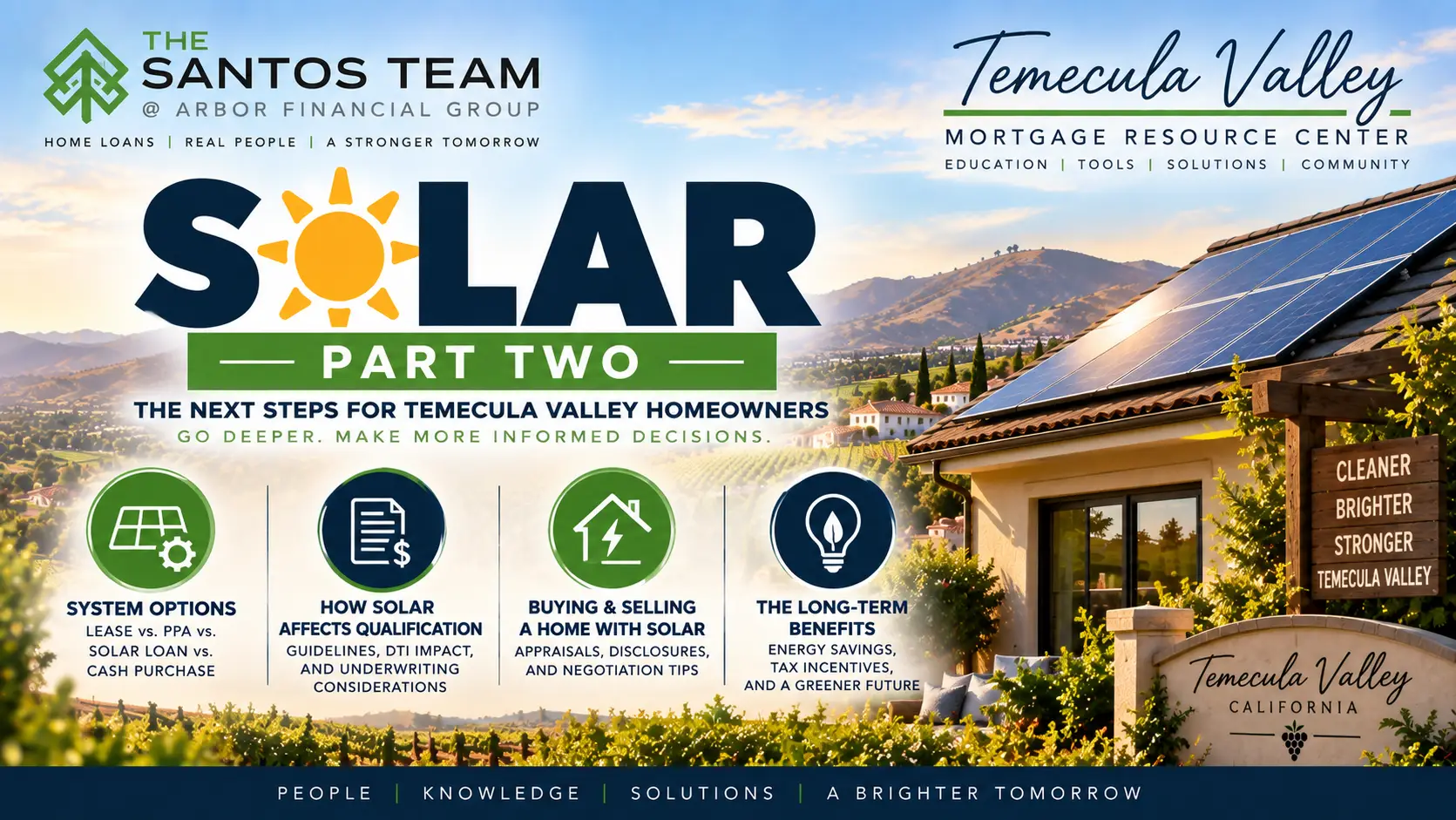
Solar has become a major part of residential real estate throughout the Temecula Valley. From Menifee and Canyon Lake to Lake Elsinore and Temecula, solar financing can directly impact a mortgage transaction—especially when a homeowner wants to refinance or sell.
In Part One, we discussed the history and some of the mortgage challenges. Now let’s look at the three primary solar financing structures we encounter.
1. PACE or HERO Solar Financing
PACE — Property Assessed Clean Energy — became one of the more controversial forms of solar financing.
Instead of a traditional mortgage lien, the financing is generally collected through the property tax bill. HERO was one of California’s most recognizable PACE programs.
The important mortgage issue is lien priority. Certain PACE assessments were structured with characteristics that could give them priority over a mortgage, creating the “super lien” concern.
PACE financing could be structured over long periods, sometimes 10–25 years or longer, with rates and fees varying substantially by program and transaction.
For mortgage purposes, this is where things can get ugly.
A homeowner may believe the solar company will simply transfer the obligation to the buyer. But the buyer’s lender, title company, and investor may have completely different requirements.
Refinancing can also become difficult because the mortgage lender may require the PACE obligation to be paid off rather than allowing it to remain ahead of—or interfere with—the new mortgage.
Bottom line: Always identify a PACE/HERO obligation early in the transaction.
2. Solar Owned With a Loan
The second structure is much more familiar: the homeowner owns the solar system and finances it with a loan.
The loan may come from:
- A credit union
- A bank
- A solar financing company
- A private lender
Terms vary significantly, but solar loans can commonly run 10–25 years, with interest rates depending on when the loan was originated, the borrower, and the financing company.
This sounds straightforward—until the homeowner wants to refinance or sell.
We’ve seen solar loans get picked to death during newer mortgage transactions.
The new lender may ask:
“Will the solar lender subordinate?”
Or:
“Can the solar lien remain on title?”
Or:
“Can the buyer assume the obligation?”
Sometimes the answer is yes.
Sometimes the answer is absolutely not.
Sometimes it’s a yes upfront, but eventually becomes a no due to the arduous process or repetitive denials for solar transfer, even though our borrowers are approved for a dramatically higher mortgage balance?
When the solar lender refuses to subordinate, or the mortgage investor won’t accept the existing lien, the homeowner may be forced to pay off the solar loan as part of the refinance or sale.
That can be a major surprise for a homeowner who was originally told the solar financing was transferable.
3. Purchase Power Agreement or Solar Lease
The third structure is a Power Purchase Agreement (PPA) or solar lease.
These are different from owning the solar system with a traditional loan.
With a PPA, the solar company generally owns the equipment and the homeowner agrees to purchase the electricity generated by the system at an agreed-upon price per kilowatt-hour.
A solar lease can instead involve a scheduled lease payment for use of the equipment.
Some lease arrangements may also provide an option to purchase the system later—sometimes for a predetermined amount, including a nominal amount at the end of the lease. That $1 purchase concept is generally a lease provision, not a standard PPA feature.
What Happens If Solar Doesn’t Produce Enough?
The homeowner generally remains connected to the utility.
If the solar system doesn’t generate enough electricity to cover household usage, additional electricity is purchased from the utility.
If the system generates more electricity than the household uses, the excess may be handled through the utility’s applicable rules, battery storage, or other arrangements depending on the system and contract.
California Solar Consumer Protection Guide
My Personal Preference: PPA or Lease
Personally, I like the PPA/lease structure better from a mortgage perspective. This is just commentary and not endorsed by Arbor Financial Group.
Why?
Because depending on the contract, these arrangements can provide:
- Protection relating to equipment performance
- Solar company responsibility for certain repairs
- Potential transferability when selling
- Potentially easier mortgage subordination
- Typically, less impact on refinancing
- Typically, less potential disruption to the transaction
That doesn’t mean every PPA or lease is mortgage-friendly, doesn’t mean this is the best for everyone, and is not an endorsement. It is just the easier of the types of solar that I have seen.
The contract still matters. I suggest getting with your realtor, mortgage lender, and possibly an attorney to review the contract and discuss the impacts of adding solar – before you sign anything.
Final Thoughts
Solar can be an excellent improvement for a homeowner, but how the solar is financed can be just as important as the panels themselves.
Before buying or refinancing a home with solar, identify exactly what type of solar obligation exists, who owns the equipment, whether there is a lien or UCC filing, whether the obligation can transfer, and whether the solar company will subordinate.
In Part Three, we’ll get deeper into UCC filings, subordination, solar valuations, requirements, and how these different solar structures interact with FHA, VA, and Conventional Mortgage Financing.