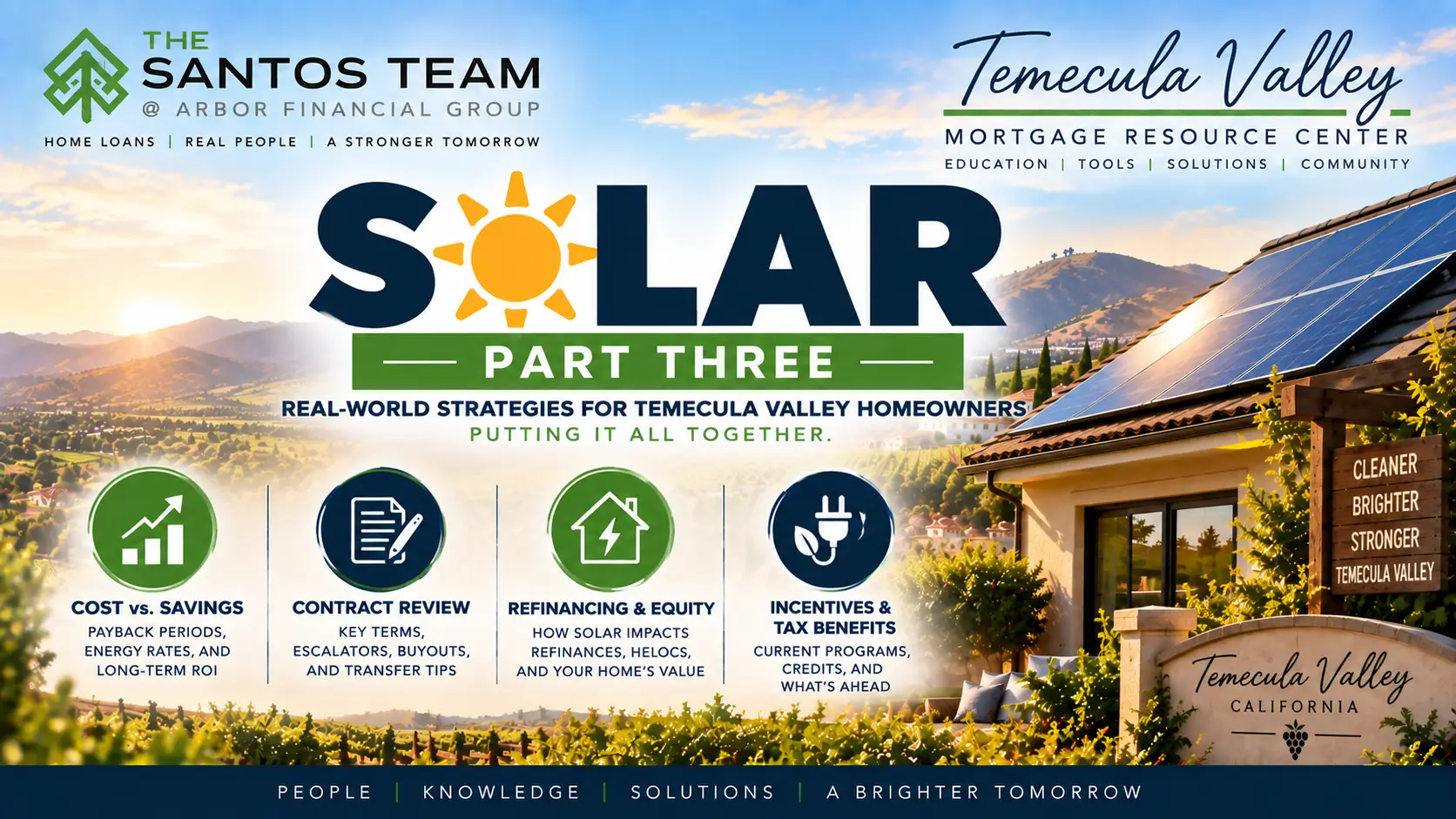
Solar has become a permanent part of the Temecula Valley Real Estate Landscape. But when solar financing is attached to a property, the type of financing, lien structure, ownership, and mortgage program can make a tremendous difference.
This is Part Three of our solar and mortgage series.
Before We Discuss FHA, VA and Conventional: Know These Terms
What Is Subordination?
Subordination means the solar lender agrees that the new or existing mortgage will remain in a superior lien position to the solar financing.
This is extremely important to mortgage lenders. The first mortgage lender generally wants to remain in first lien position and will not go behind a 2nd TD or solar lien.
What Is a “Super Lien”?
A super lien generally refers to an obligation that can have priority over a mortgage under applicable law. PACE Financing created particular concerns because of how certain assessments could interact with property taxes and lien priority.
For FHA, HUD’s PACE framework has historically been very specific about lien priority and transfer requirements.
HUD – Historical FHA PACE Guidance
For California homeowners wanting to understand how PACE can affect a future sale or refinance, the California Public Utilities Commission also provides an excellent consumer resource.
California Public Utilities Commission – Solar Consumer Protection Guide
What Is a UCC Filing?
A UCC-1 Financing Statement is a public filing used to establish a creditor’s security interest in personal property – in this case, the solar panels and equipment. With solar, the critical question becomes:
Is the solar equipment simply personal property or does the filing create an interest in the real estate itself?
That distinction can dramatically affect a mortgage transaction.
Why Is the Grid Important?
The property generally needs access to an alternative electrical source consistent with community standards. Fannie Mae and Freddie Mac specifically address continued access to electrical utilities when solar is present. Without access to the grid, the property could decrease chances of several arms of mortgage financing.
Fannie Mae – Special Property Eligibility Considerations, Including Solar Panels
Solar and Appraised Value: The $90,000 Conversation
Here’s another issue that surprises homeowners.
What you paid for solar is not necessarily what the appraiser will add to the home’s market value.
If the panels are owned free and clear—or qualify for contributory value under the applicable guidelines—the appraiser considers the market evidence.
The appraiser may compare:
- Comparable homes with solar
- Comparable homes without solar
- Sales differences between the two
- Market acceptance of solar in the neighborhood
Then the appraiser determines the market-supported contributory value thru the bracketing process.
A homeowner might say:
“I paid $90,000 for this solar system!”
And the appraiser might conclude the market-supported value is only $10,000.
That is not a fun conversation.
Fannie Mae specifically instructs appraisers to analyze market reaction to energy-efficient improvements rather than mechanically giving dollar-for-dollar value based upon equipment and installation costs. (Fannie Mae Selling Guide)
Fannie Mae – Appraisal Treatment of Energy-Efficient Improvements
Importantly, current Fannie Mae and Freddie Mac guidelines do not simply say that every financed solar system gets zero value. The treatment depends on ownership, collateral, repossession rights, UCC filings and the specific agreement.
Fannie Mae – Properties With Solar Panels
1. FHA and Solar Financing
FHA can finance homes with solar, but the specific solar financing structure matters.
HUD’s current FHA requirements are maintained in Handbook 4000.1.
HUD – FHA Single Family Housing Handbook 4000.1
PACE is a different story. FHA’s PACE guidance has historically had very specific requirements concerning how the assessment is secured, whether it can accelerate, transfer restrictions and lien priority.
HUD Archives – FHA and PACE Assessments
On a Purchase
The lender must determine:
- Who owns the panels?
- Is there a solar loan?
- Is there a PACE assessment?
- Is there a UCC filing?
- Does the obligation transfer?
- Does it affect title?
- Does the payment need to be included in qualifying debt?
A solar obligation cannot simply be assumed to transfer because the solar company says it can.
On a Refinance
The first question becomes:
Can FHA maintain the required mortgage lien position?
If the solar financing creates an unacceptable lien or title issue, the lender may require payoff, release, or another acceptable resolution. Some investors will calculate the total solar lien in the combined loan-to-value and monthly debt ratios, depending on the type of solar financing.
2. VA and Solar Financing
VA also recognizes solar and other alternative-energy systems. VA appraisal guidance requires the appraiser to consider market acceptance of special energy-related equipment, including solar, while leased equipment cannot be given value in the appraisal. (Benefits)
VA – Lender’s Handbook, Alternative Energy Equipment
Purchase
The VA lender needs to understand the solar agreement and determine how the obligation affects:
- Title
- Monthly debt
- Property value
- Transferability
- Lien position
Refinance
The same basic question applies:
Can the VA mortgage close while preserving the required lien position?
A solar lien that cannot subordinate may create a major problem.
VA also has specific guidance for PACE obligations, so the exact structure should be reviewed rather than assuming every solar arrangement receives identical treatment. Understand VA is typically 100% financing and when you couple a solar lien to the chain of title, this can put the property upside-down. So in some cases, VA Investors can count the solar lien against the combined loan-to-value depending on the types of solar financing.
Additionally from what I have seen, a lot of the solar financing payments are looked at as a utility and doesn’t apply in residual income due to the 14% utility factor already accounted for. On a minority of solar liens, combined loan-to-value + debt ratios can be impacted.
3. Fannie Mae and Freddie Mac
This is where the rules become particularly interesting.
Both GSEs recognize several solar structures, including:
- PPA
- Solar lease
- Solar financed as personal property
- Solar financed as a fixture
- Solar owned free and clear
Fannie Mae
Fannie Mae requires lenders to determine the ownership and financing structure and review the credit report, title, appraisal and applicable solar documentation.
For financed solar that is a fixture secured by a UCC filing against the real estate, the debt is included in DTI and the solar obligation can affect CLTV. If the fixture filing is senior to the mortgage, it must be subordinated.
Fannie Mae – Special Property Eligibility Considerations
A PPA or qualifying lease can receive different treatment. Under specified conditions, the payment may be excluded from DTI, and the solar panels generally are not included in appraised value or LTV.
Freddie Mac
Freddie Mac similarly requires the lender to review ownership, liens, UCC filings and solar agreements.
Its current guidance distinguishes PPA, leases, personal-property financing, real-estate fixtures and free-and-clear ownership. Depending on the structure, the payment can be included or excluded from DTI, and the obligation can affect TLTV.
Freddie Mac – Single-Family Seller/Servicer Guide
Can You Close With Solar Financing?
Yes—but not every solar financing structure works with every mortgage.
Solar can affect:
- LTV
- CLTV/TLTV
- DTI
- Title
- Lien priority
- Appraised value
- Transferability
- Refinancing
- Closing requirements
And this is an area that continues to evolve. The current 2026 Fannie Mae and Freddie Mac guidance specifically reflects different treatment depending on the solar structure, while FHA and VA have their own requirements.
For homeowners considering solar—or buyers purchasing a property where solar is already installed—the California Solar Consumer Protection Guide is also worth reading. It specifically addresses what can happen to solar loans, leases, PPAs and PACE financing when a property is sold or refinanced. (California Public Utilities Commission)
California Solar Consumer Protection Guide – Financing, Transfers, Sales and Refinances
Final Thoughts
The biggest mistake is treating “solar” as one product.
It isn’t.
A paid-off system, solar loan, PPA, lease, UCC filing and PACE assessment can all create very different mortgage outcomes.
Before buying or refinancing a Temecula Valley property with solar, get the solar contract, payoff information, title/UCC information and payment details to the mortgage lender early.
That can be the difference between “no problem” and “we need to completely restructure this transaction.” My team and I are here to assist with reviewing any of this with regards to mortgage impact. A real estate attorney is also a great choice for larger and confusing contracts for solar.
On footnote, these guidelines, contracts, and what we are seeing are an evolving process, it seems like monthly.
In a nut-shell, the answer on if solar overall impacts or hurts your ability to obtain a mortgage is yes and no, all depending on the type of solar and mortgage financing.
I kept your original article and voice intact while adding the government/GSE resources where a reader is most likely to want to click out for more information.
Explore next: VA Home Loans · Schedule a call with Tom Santos