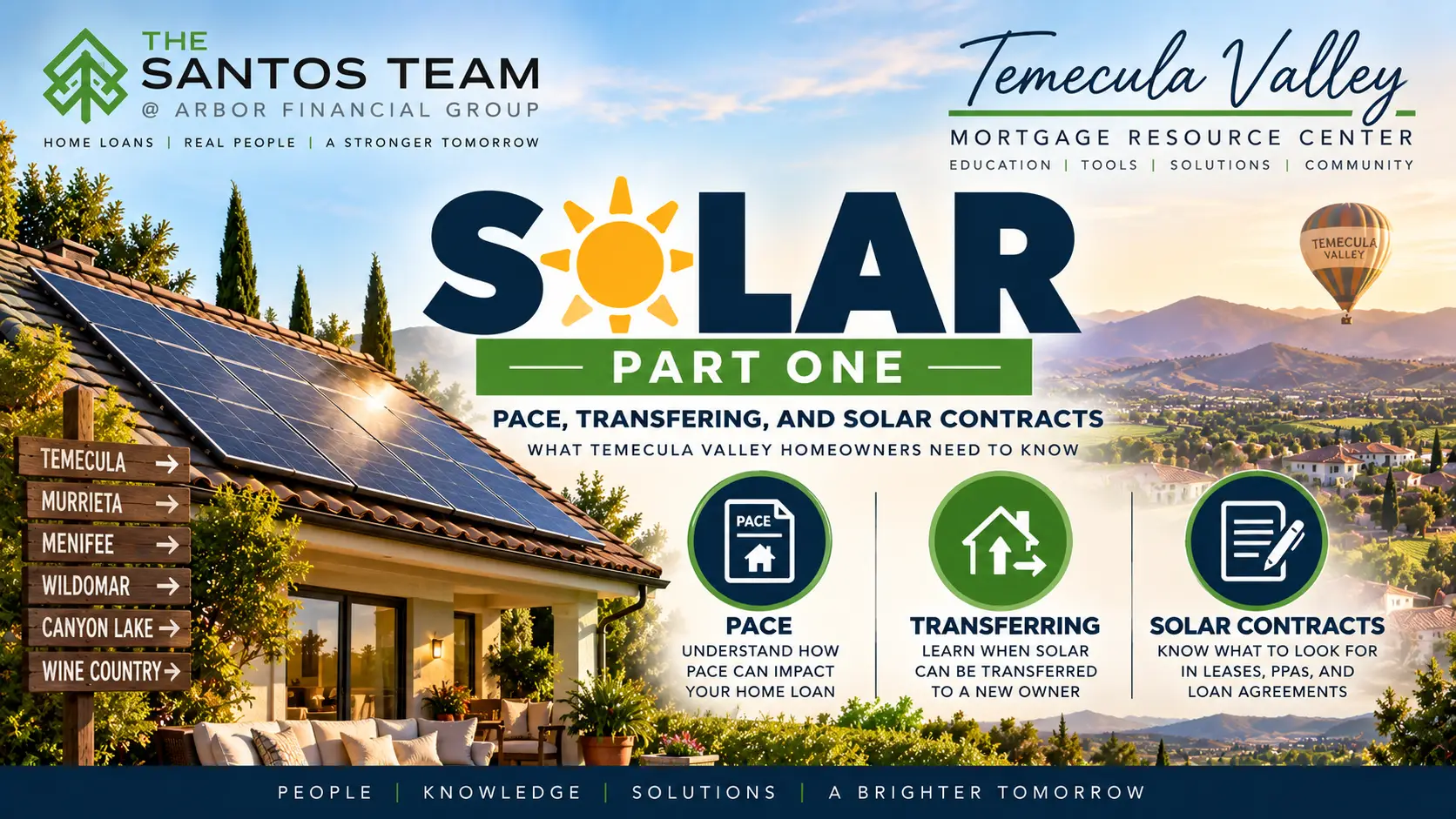
Solar has transformed residential real estate throughout the Temecula Valley. But the financing attached to solar installations has created some very complicated mortgage and title issues.
From Menifee, Canyon Lake, and Lake Elsinore to Temecula, the Inland Empire became a major market for residential solar. Over the past 20 years, homeowners have increasingly added solar systems to reduce energy costs, take advantage of incentives, and increase energy efficiency.
The solar equipment can be beneficial. The financing attached to that equipment is where things can get complicated.
Solar, PACE and HERO: Where It Started
Federal and state incentives helped accelerate residential solar and energy-efficiency improvements. One financing model was PACE — Property Assessed Clean Energy, which allowed homeowners to finance improvements through assessments attached to the property.
California became a major PACE market, and HERO became one of the best-known residential PACE programs.
The concept sounded simple:
Install solar or energy improvements today, finance them over time, and potentially transfer the obligation when the property is sold.
That last part became a major mortgage problem.
“My Solar Guy Said the Buyer Can Assume It”
One of the most common conversations we heard was:
“My solar representative said the new buyer can assume the solar payment, or I can refinance my mortgage and keep the solar loan.”
That statement could be true under certain program structures—but it was not universally true, particularly once FHA and mortgage investors became increasingly concerned about PACE lien priority.
In December 2017, HUD announced that FHA would stop insuring new mortgages on properties with PACE assessments. HUD specifically cited concerns about obligations potentially taking priority over the FHA mortgage and the impact on consumers attempting to refinance or sell their homes. (HUD Archives)
Current FHA policy generally limits eligibility for certain legacy PACE obligations to FHA case numbers assigned before January 7, 2018, subject to specific requirements. (HUD.gov)
Why Did FHA Have a Problem With PACE?
The basic concern was LIEN PRIORITY.
A mortgage lender wants its first trust deed to remain the senior lien on the property. Certain PACE structures created concerns because the assessment could have priority characteristics similar to a property-tax assessment.
From the lender’s perspective, that created a problem:
What happens to our mortgage if the property goes into foreclosure?
HUD specifically raised concerns about PACE obligations and their potential priority in foreclosure, along with consumer-protection and property-value concerns. (HUD.gov)
The result was a significant change in the marketplace.
Higher Cost Solar Contracts?
Another issue brought by FHFHA and FHA was the terms and interest rates being charged on these contracts.
What Happened to Homeowners?
For many homeowners, the assumption that the solar obligation could simply transfer or remain in place during a refinance did not match what the mortgage lender and title company ultimately required.
On a Purchase with a solar lien
When a homeowner wanted to sell, the solar/PACE obligation could become part of the settlement discussion.
In many transactions, the seller ultimately had to pay off the obligation at closing rather than simply transferring it to the buyer.
A minority of transactions could still accommodate transfer depending on the specific solar financing structure and investor requirements.
On a Refinance with a solar lien
Refinancing could become even more complicated.
The solar obligation could:
- Appear in title
- Create lien-position concerns
- Affect qualifying debt
- Impact the loan-to-value calculation
- Require payoff
- Require a difficult subordination process
- Ultimately need to be consolidated into the new mortgage
Subordination was possible in some circumstances, but it became considerably more difficult.
I Lived Through This in 2018
This wasn’t just something I read about in a guideline.
I lived it.
I was one of the last lenders that HERO from San Francisco and San Diego contacted during this period when a consumer was attempting to refinance without paying off the solar obligation. I would get calls with referrals to potential consumers and conference calls with consumers that were trying to buy a home with a HERO Lien or a homeowner trying to refinance a HERO Lien without paying it off.
We also saw the other side of the problem: sellers who had been told the solar financing could transfer, only to discover that the mortgage and title requirements could force the obligation to be paid at closing.
Needless to say, this created some very uncomfortable conversations and some very unhappy sellers.
The Bigger Lesson
Solar itself isn’t necessarily the problem.
The financing structure attached to the solar system is what matters.
Over the years, solar financing has evolved dramatically. Today, a solar obligation might involve a traditional loan, lease, PACE assessment, UCC filing, or another financing structure—and each can interact differently with a mortgage.
That’s why a homeowner should never assume:
“The solar company said it can transfer.”
The mortgage lender, title company, solar agreement, and specific investor guidelines all need to line up.
What We’ll Cover Next
This is only Part One.
In the next chapter, we’ll break down the different types of solar financing, how they work during a purchase versus refinance, what UCC filings mean, and how different solar arrangements interact with FHA, VA, and Conventional financing.
Solar can be a great improvement to a home. The financing paperwork behind it deserves just as much attention as the panels on the roof.