When most people think about their credit score, they usually ask one simple question:
“Do I pay my bills on time?”
For decades, that was the primary way lenders judged creditworthiness. While payment history is still typically the single most important factor in mortgage lending, modern credit scoring also places significant emphasis on debt utilization.
Understanding both can help you qualify for a better mortgage in the Temecula Valley.
The Traditional View of Credit
Historically, credit was a simple checks-and-balances system.
- Do you pay your bills on time?
- Have you ever been late?
- Have you defaulted on any debt?
- Do I have enough credit?
These questions remain the foundation of every credit score. A borrower with a long history of making payments on time will almost always score better than someone with repeated late payments.
What Is Debt Utilization?
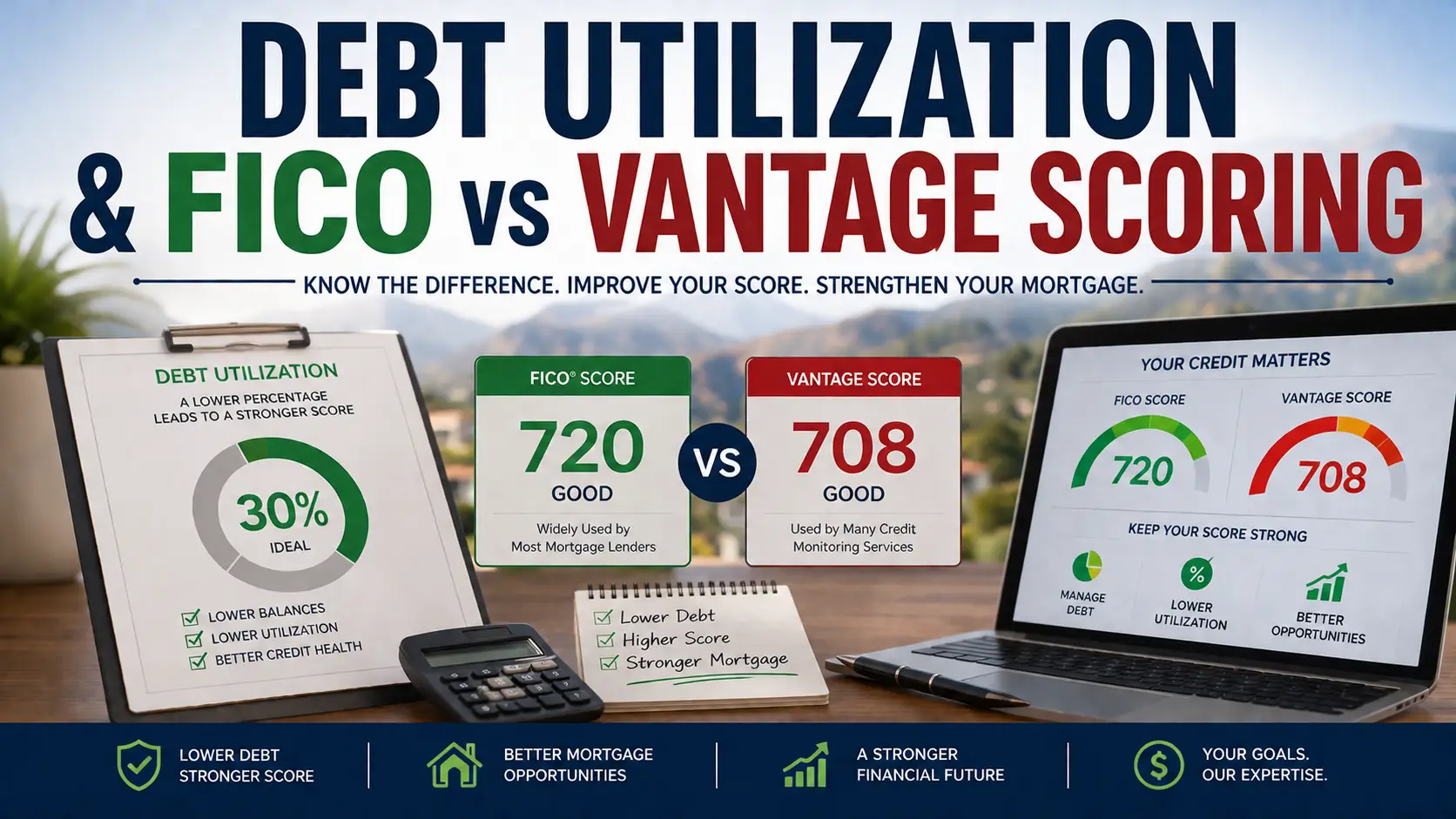
Debt utilization measures how much of your available revolving credit you’re currently using.
The calculation is straightforward:
Current Balance ÷ Credit Limit = Debt Utilization
For example:
- Credit Limit: $10,000
- Current Balance: $2,000
- Debt Utilization: 20%
Generally speaking:
- 0-10% – Excellent
- 10-30% – Very Good
- 30-50% – Moderate impact
- Over 50% – Increasing negative impact
- Near Maxed Out – Significant negative impact
Consumers are often surprised that paying a credit card down—even without paying it off completely—can improve their score simply by lowering utilization.
How FICO Looks at Credit
FICO remains the dominant scoring model used for mortgage lending today.
FICO is generally top-heavy on payment history. If you consistently pay your obligations on time, you’ve already addressed the largest component of your score.
Debt utilization then becomes the next major factor. Even borrowers who never miss a payment can see lower scores if their revolving balances remain too high.
Think of it this way:
- Did you pay as agreed?
- How much available credit are you using?
- Then everything else, including account age, credit mix, and recent inquiries.
Enter VantageScore
A newer scoring model, VantageScore, has gained traction throughout the consumer lending industry.
While both FICO and VantageScore consider many of the same credit characteristics, VantageScore generally places greater emphasis on debt utilization and current revolving balances than earlier mortgage scoring models.
For consumers who carefully manage credit card balances, this may result in different scores than traditional FICO models.
Changes Coming to Mortgage Lending
One of the biggest developments in the mortgage industry is the transition toward allowing both FICO and/or VantageScore for loans purchased by Fannie Mae and Freddie Mac.
In addition, the GSEs are working toward replacing today’s traditional tri-merge credit report (three bureaus and three scores) with a bi-merge credit report, using only two national credit bureaus and two credit scores.
The goals include:
- More competition among the credit bureaus.
- Helping reduce the cost of mortgage credit reports to consumers.
- Giving lenders additional scoring options.
- Potentially allowing more borrowers to qualify for improved pricing, depending on their credit profile.
When Will These Changes Arrive?
The transition has already been announced and work is underway across the industry. However, implementing new credit scoring models requires updates from:
- Fannie Mae
- Freddie Mac
- Loan origination software providers
- Automated underwriting systems
- Credit reporting companies
- Mortgage insurance companies
- Individual lender guidelines
- Final loan document bundles
Because of the size of this undertaking, implementation has moved more slowly than originally anticipated.
While timelines can change, many industry professionals expect broader adoption to continue later this year and into 2027.
Final Thoughts
Credit scoring continues to evolve. Payment history remains the foundation of mortgage qualification, but debt utilization has become one of the fastest ways to improve—or hurt—your score.
As FICO and VantageScore become available side by side for mortgage lending, consumers may have more opportunities to qualify for better pricing by actively managing their revolving credit before applying for a mortgage.
If you’re planning to purchase or refinance in the Temecula Valley, reviewing your credit months before applying can provide valuable opportunities to improve your scores and expand your financing options.