For nearly two decades, the words “no income” and “stated income” have reminded many people of the 2008 housing crisis. Today, however, a very limited number of specialty mortgage investors have introduced products that revisit alternative underwriting—but with significantly different safeguards than those seen before the 2008 financial crisis.
Looking Back at 2008
Before the mortgage crisis, many lenders offered stated-income loans, often referred to as “liar loans.”
In many cases, borrowers simply stated their income without providing documentation. Combined with 80/20 financing, 100% financing, and little or no money down, these products allowed buyers with strong FICO scores to purchase homes with virtually no financial investment.
Many loans were packaged together into mortgage-backed securities and sold on Wall Street. The movie “The Big Short” provides an excellent overview of how mortgage packaging, investor demand, and underwriting practices contributed to the financial crisis.
After 2008, stated-income lending virtually disappeared.
A New Generation of Alternative Financing
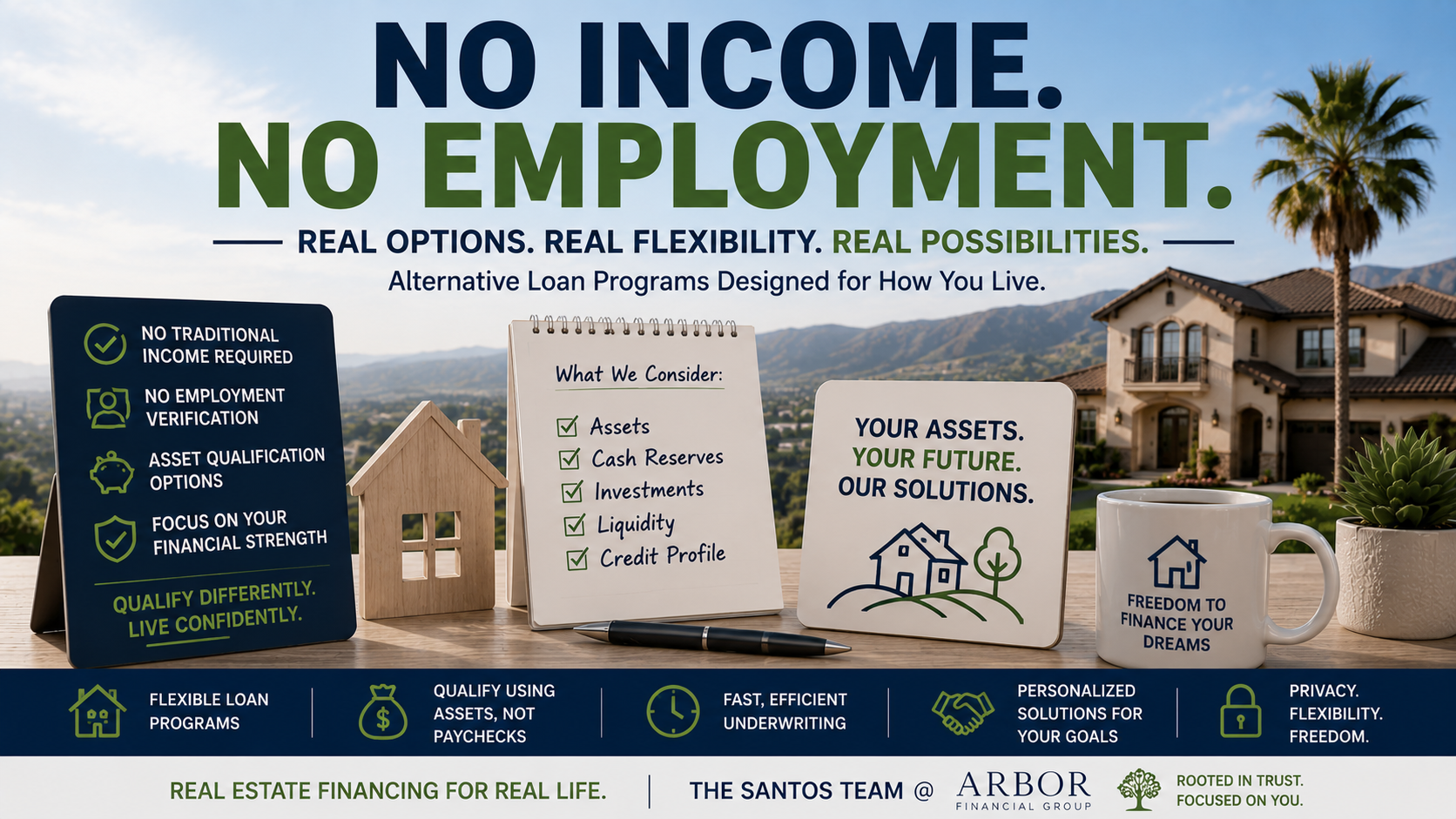
Today, a small number of institutional investors are cautiously reintroducing No-Income/No-Employment mortgage products.
Unlike the pre-2008 era, these loans generally require substantial borrower equity, strong credit, significant reserves, full appraisals, and much tighter underwriting. They are considered Non-QM (Non-Qualified Mortgage) products and use alternative methods to evaluate a borrower’s ability to repay rather than traditional employment and income documentation. Two of these three products fall under CDFI classification.
Investor Option #1
Typical highlights include:
- 680+ FICO score
- No employment and no income stated on the application
- Purchase or refinance
- Primary residence or 2nd Home
- 30-year fixed-rate financing
- Potential pricing discounts through certain CDFI programs (call for details)
- Loan amounts up to $3,000,000
- Six months of required cash reserves
- Cash-out refinances under $999,999 may allow cash proceeds to satisfy reserve requirements, subject to investor guidelines
- Full appraisal required
- Generally, requires a substantial down payment or significant equity
For qualified borrowers, this program can be one of the simplest institutional loan options available and often serves as a bridge between traditional mortgage financing and much more expensive private or hard money loans.
Investor Option #2
A second investor offers an even more specialized program with tighter underwriting:
- 700+ FICO score
- No traditional income or employment documentation
- Purchase or refinance
- Primary residence or 2nd Home
- 3/1 or 5/1 Fixed/ARM options
- Competitive short-term pricing
- Loan amounts up to $3,000,000
- Twelve months of PITI (Principal, Interest, Taxes, and Insurance) deposited into a Certificate of Deposit and generally held for at least 13 months, subject to program terms
- Reserve funds must be the borrower’s own assets
- Full appraisal required
- Minimum 35% down payment
- Typically only urban and suburban settings, rural properties can be a challenge
- Very conservative underwriting
Although underwriting is stricter, borrowers may benefit from aggressive pricing for a loan that doesn’t rely on traditional employment verification.
Who Might Benefit?
These products may fit borrowers who have:
- Recently become self-employed.
- Switched from W-2 employment to business ownership.
- Irregular or seasonal income.
- Significant assets but limited documentable income.
- Recently retired.
- Experienced a career transition.
Before these programs became available, borrowers who couldn’t document traditional income often had few choices beyond hard money or private-money financing, where interest rates and fees are typically much higher. But even hard or private money fell under the ability to repay requirement for a primary residence.
Final Thoughts
No-Income and No-Employment mortgage products are not making a broad comeback—but carefully designed versions are slowly returning to the marketplace through select Non-QM or CDFI Investors.
These loans are highly specialized and are not appropriate for every borrower. However, for well-qualified applicants with strong credit, meaningful equity, and substantial reserves, they may provide an attractive alternative to both conventional financing and expensive private lending.
If you think your situation doesn’t fit traditional underwriting, it may still be worth exploring today’s alternative mortgage options. The lending landscape has evolved considerably since 2008, and in some cases, these niche products can open doors that weren’t available just a few years ago.