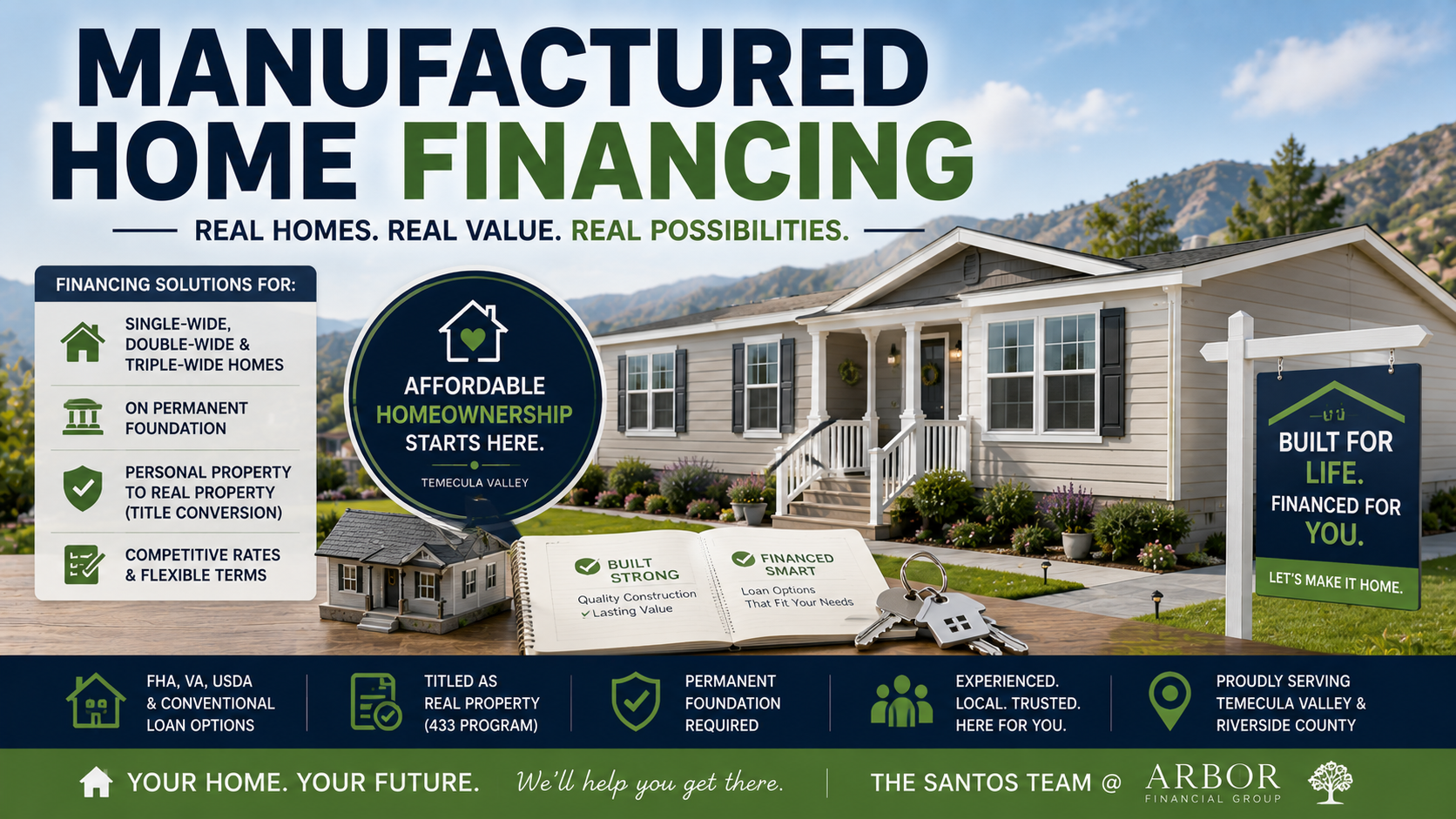
Manufactured Homes have become an increasingly popular housing option throughout the Temecula Valley, especially in Wine Country, Aguanga, Anza, and other rural communities where buyers can own acreage at a more affordable price than with traditional site-built homes.
Fortunately, several financing options are available—but eligibility depends largely on how you intend to occupy the property.
Occupancy Comes First
Before discussing loan programs, lenders first determine the occupancy type.
1. Primary Residence
This is by far the easiest property type to finance and offers the widest variety of loan programs.
2. Second Home
Financing becomes more limited for vacation or second homes. While some Conventional lenders will finance manufactured homes as second homes, fewer lenders offer these programs, and qualifying guidelines are generally stricter.
3. Investment Property
Investment financing for manufactured homes is the most limited. Most traditional government and agency programs do not permit this occupancy type, making specialty financing the primary option.
FHA Financing
FHA remains the most common financing program for manufactured homes because of its flexible underwriting guidelines.
Typical requirements include:
- Primary residence only.
- Manufactured on June 15, 1976, or newer.
- Double-wide or larger.
- Permanent foundation.
- HUD Foundation Engineering Certification confirming the foundation meets HUD standards.
- Documentation showing the home has never been double moved.
- Converted to real property.
FHA typically allows:
- 3.5% minimum down payment
- Credit scores starting around 620, depending on lender requirements
- Interest rates that are often very comparable to traditional single-family homes
For many first-time homebuyers, FHA remains the most accessible manufactured housing program.
VA Financing
Although the Department of Veterans Affairs handbook provides somewhat broader guidance, many lenders apply underwriting standards very similar to FHA when financing manufactured homes.
Following the FHA property requirements generally puts VA borrowers on the right path.
Typical lender requirements include:
- Primary residence.
- June 15, 1976, or newer.
- Double-wide or larger.
- Permanent foundation meeting HUD standards.
- Never double moved.
- Converted to real property.
VA’s biggest advantage is that qualified veterans may finance up to 100% of the purchase price, with many lenders accepting credit scores beginning around 620, subject to underwriting.
Conventional Financing (Fannie Mae & Freddie Mac)
Conventional financing is available for many manufactured homes but generally has stricter credit and down payment requirements.
Most lenders offer Conventional financing for:
- Primary residences.
- Second homes.
Most do not finance manufactured homes as investment properties through Fannie Mae or Freddie Mac.
Typical requirements include:
- Minimum 5% down payment
- Credit scores generally 700 or higher for the most competitive financing
- Permanent foundation
- Real property conversion
- Double-wide or larger
- June 15, 1976, or newer
- Expect to also pay monthly mortgage insurance with less than 20% down
Borrowers with stronger credit profiles often benefit from competitive interest rates and reduced mortgage insurance costs compared to FHA.
USDA Financing
USDA financing technically permits manufactured housing under its published guidelines.
However, finding a lender willing to fund USDA manufactured home loans has become increasingly difficult.
Although several lenders advertise USDA manufactured home financing, very few actually originate and close these loans. In practice, USDA manufactured home financing remains extremely limited despite being available on paper.
Specialty Financing (Non-QM)
One of the newest developments in manufactured housing is the expansion of Non-QM Financing.
While uncommon, we have successfully funded manufactured homes in 2026 using specialty products that include:
- 12-month Bank Statement Loans for self-employed borrowers.
- DSCR (Debt Service Coverage Ratio) Loans for investment properties.
These programs are highly niche and typically require stronger credit profiles, larger down payments, and higher reserves than traditional government financing. However, they provide opportunities that many borrowers don’t realize exist—particularly for manufactured homes used as rental properties. This product fills a needed void for more than 10 years, with regards to investment property manufactured housing.
Final Thoughts
Manufactured homes on permanent foundations now qualify for more financing options than ever before. FHA and VA remain the most common choices for owner-occupied homes, Conventional Financing works well for qualified primary and second-home buyers, and specialty Non-QM programs have opened the door for select investment property opportunities.
The key is working with a lender experienced in manufactured housing. Verifying the home’s foundation, title conversion, HUD compliance, and movement history before writing an offer can save time, reduce stress, and help ensure the property qualifies for the financing program that best fits your budgetary goals in the Temecula Valley.
Explore next: Find My Best Mortgage · Schedule a call with Tom Santos