For self-employed borrowers, purchasing real estate in the Temecula Valley can become increasingly difficult as property values rise. From De Luz to Fallbrook, Santiago Estates to Wine Country, and Los Ranchitos to Meadowview, higher purchase prices can create a significant qualifying challenge—especially when traditional tax-return underwriting does not accurately reflect the cash flow of a successful business. Values in these areas have been pushing up dramatically since 2018.
That is where 12-month bank statement mortgage financing has become an important alternative.
What Happened to Bank Statement Lending?
Alternative lending, asset-based lending, and bank statement programs essentially disappeared from the mainstream mortgage marketplace after the 2008 financial crisis. Post-2008 underwriting became heavily focused on documented tax returns, W-2s, paystubs, and standardized agency guidelines.
Beginning after 2020, however, Non-QM lending experienced a significant resurgence.
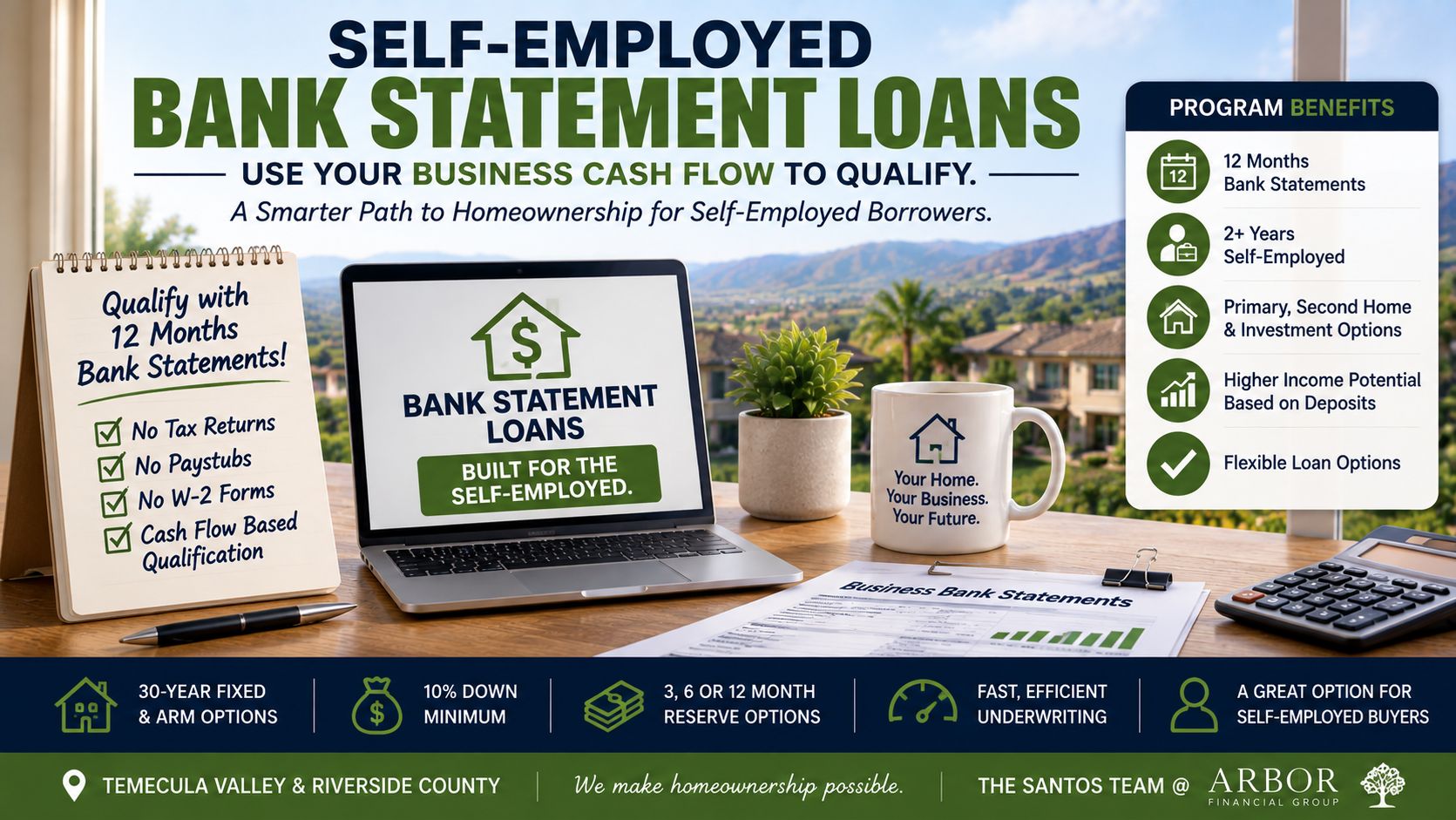
Today, qualified self-employed borrowers may have an alternative to traditional tax-return underwriting: using 12 months of business or personal bank statements to demonstrate cash flow and repayment ability.
Who Typically Qualifies?
These programs are generally designed for borrowers who have been self-employed for at least two years, typically with the same business.
Self-employment may be documented through items such as:
- CPA or accountant documentation
- Business license
- Professional license
- Other documentation establishing ownership and history
The exact documentation varies by investor.
Occupancy Options
One major advantage is flexibility.
Depending on the investor, bank statement financing may be available for:
- Primary residences
- Second homes
- Investment properties
The program tends to be especially attractive for primary-residence buyers whose tax returns significantly understate the cash flow available to make a mortgage payment.
Credit Requirements
Credit standards vary by investor, but a common range is:
- 640+ FICO: Potential minimum for certain programs
- 680+ FICO: Often provides better pricing and broader options
- Stronger credit can improve interest-rate and loan-structure choices.
These are generally Non-QM loans, not government-backed FNMA, FHLMC, FHA, VA, or USDA financing.
Down Payment and Assets
A common minimum is approximately 10% down, although putting 20% or more down is much more typical.
Some programs may require a higher rate at 10% down because of the additional risk and the lack of traditional mortgage insurance structures. In essence, imbedding the risk premium into the interest rate vs charging it as a separate premium. In the government financing realm, this is known as self-insuring MI.
The down payment must be documented, and some programs allow qualifying gift funds.
Reserve requirements are also common, with investors potentially requiring 3, 6, or even 12 months of reserves, depending on the property, loan amount, credit profile, and overall transaction.
How 12-Month Bank Statement Income Works
Instead of analyzing taxable income from tax returns, the lender reviews the borrower’s 12 months of bank statements.
The lender generally analyzes deposits and removes items that should not be considered income, including:
- Transfers between the borrower’s own accounts
- Cash deposits
- Certain non-business deposits
- Other deposits that cannot reasonably be considered recurring business revenue
After eligible deposits are totaled, an appropriate business expense factor is applied.
Example: $500,000 in Annual Deposits
Assume a business has:
12-month deposits: $500,000
Business expense factor: 30%
Net percentage used: 70%
Calculation:
$500,000 × 70% = $350,000
Then:
$350,000 ÷ 12 = $29,166.67 per month
In this example, approximately $29,167 per month would be the qualifying monthly income before applying the program’s other underwriting requirements. As a part of the pre-approval process, we usually have underwriting review the bank statements, spreadsheet the deposits, and give us an income factor to use. This takes the surprises out of things.
What Is the Business Expense Factor?
The expense factor attempts to account for the cost of operating the business.
As a general example, a small two-person operation might receive a 25%–30% expense factor, while a business with three to five true employees might have a 35%–40% factor.
These are examples—not universal rules. The actual factor depends on the investor, business type, documentation, and program. As is the type of business, top-heavy selling retail goods vs a service-oriented business – can also impact the business expense factor.
Importantly, true employees are different from independent contractors or subcontractors when determining the appropriate expense factor.
Some investors may also accept a CPA letter supporting the appropriate business expense percentage.
Bank Statements Are Still Underwritten
Bank statement financing does not mean the lender simply adds up deposits and approves the loan.
The statements are reviewed for overall financial health, including:
- Negative balances
- Overdrafts
- Excessive returned payments
- Irregular cash flow
- Signs of financial strain
- Large unexplained deposits
- Consistency of business activity
The objective is to determine whether the documented cash flow supports the proposed mortgage payment. Consistency is the main word here, consistent deposits monthly.
Available Loan Structures
Depending on the investor, borrowers may have access to:
- 30-year fixed
- 3/1 Fixed/ARM
- 5/1 Fixed/ARM
- 7/1 Fixed/ARM
- Interest-only options
For primary residences, programs in California typically offer no prepayment penalty, while second-home and investment-property options may have different rules.
Why Consider Bank Statement Financing?
For the right self-employed borrower, the advantages can be substantial.
Potential Benefits
- No traditional tax-return income calculation
- Less concern about legitimate business deductions reducing qualifying income
- Qualification based on documented cash flow
- Potentially higher qualifying income than the tax-return method
- Primary, second-home, and investment options with certain investors
- Flexible loan structures
- Ability to finance higher-value properties when agency qualification becomes restrictive
- Avoids the need of using a 24 month average of tax returns, avoiding year one of two watering-down the average. Many folks who just started out, have a much lighter first tax year vs the second year. We are forced to use a 24 month average on normal full documentation qualifying. With the bank statement route, we are looking at a 12 month snapshot only for cash-flow.
This can be particularly valuable for successful business owners who earn substantial revenue but show considerably less taxable income after legitimate deductions. And in some cases, prevents borrowers from over-filing taxable income, just to try and qualify for buying a home.
What Are the Trade-Offs?
Bank statement financing is not free money, and it is not automatically better than conventional financing.
Typically:
- Interest rates may be approximately 0.50% to 1.00% higher than comparable traditional financing, depending on the scenario.
- These are generally Non-QM products, not government loans.
- Credit must still be acceptable.
- Reserve requirements can be substantial.
- Down payment requirements may be higher.
- Property and occupancy restrictions can apply.
- Impound accounts for property taxes and homeowners insurance are commonly required.
Final Thoughts
For self-employed borrowers in the Temecula Valley, 12-month bank statement financing can create a bridge between traditional institutional lending and more expensive private-money financing.
When tax returns make a borrower look less qualified than the actual cash flow of the business, a bank statement program may provide another path to homeownership.
The key is comparing the traditional tax-return route against the bank statement route side by side—then determining which option provides the best combination of qualification, interest rate, down payment, reserves, and long-term cost.